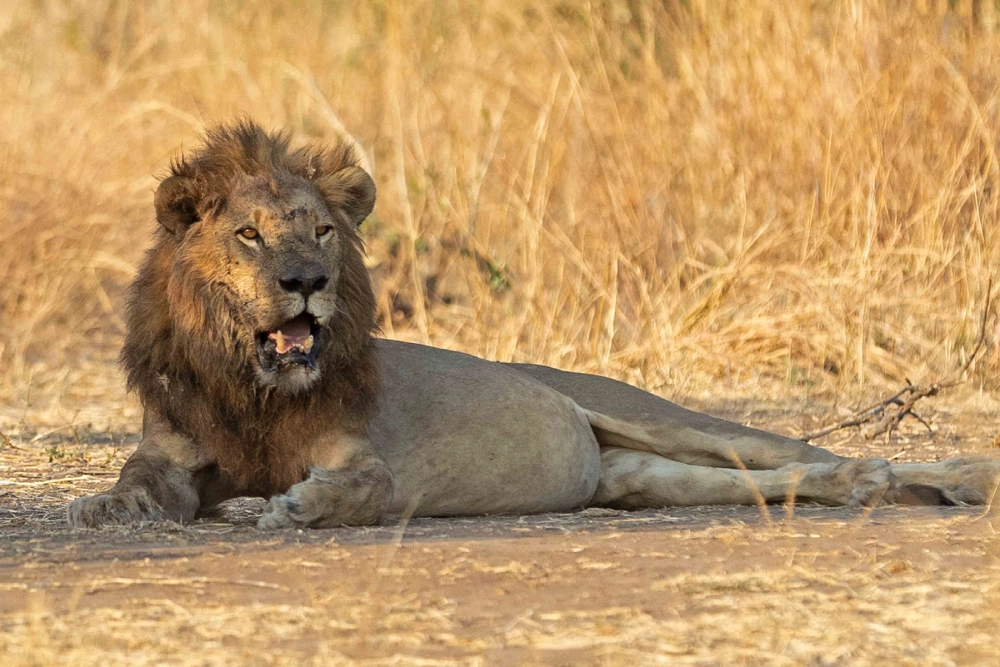
August in Hwange is surely one of the best times to visit. Clear sunny skies, warm daytime temperatures, and the arrival of the first avian migrants herald a palpable feeling of Spring. Teak trees are resplendent in gorgeous shades of orange and bronze and abundant golden grass waves in the breeze.
At Detema campsite, where we set up camp for three nights, the local lion pride, comprising two lionesses and three males, sauntered down for a refreshing evening drink at the pan within an hour of our arrival. The males kept up a deafening chorus until the early morning hours with their roars.
The following night, the same pride took on and killed a well-grown hippo that kept them fed for days and provided scraps for several opportunistic black-backed jackals and throngs of vultures that sat clustered in the nearby trees awaiting their turn at the kill.
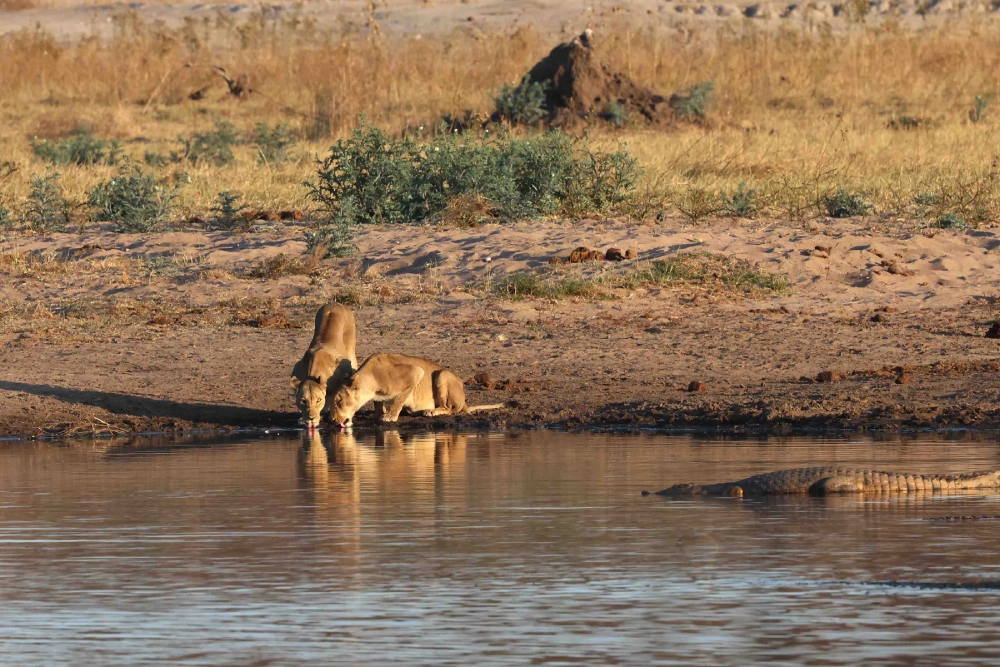
Asides from our feline visitors, the pan was visited non-stop by various animals coming to quench their thirst – curious, quizzical giraffe, dazzling groups of zebra, large herds of impala, a group of eight male kudu with magnificent spiraling horns and various families of warthogs enjoying a splashy mud bath. A troop of baboons kept us entertained for ages, and of course a procession of elephants from midday onwards enthralled us with their antics at the water. The pan was occupied by several enormous crocs and two adult hippos, one with a very small calf at foot.
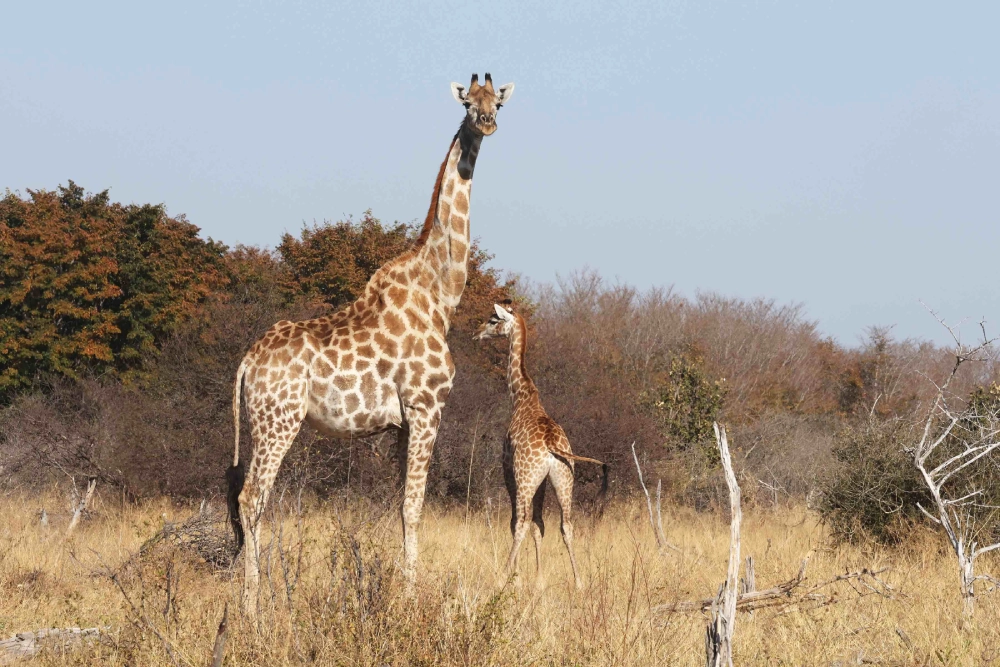
Moving to Kennedy Campsite, we got up close and personal with a large bull elephant that stepped over the fence intent upon shaking several Camelthorn trees (Acacia erioloba) in the dead of night, showering our tents with pods. He proceeded to hoover these up with obvious, noisy relish, paying no heed to the wide-awake, dead-silent occupants of the tents only one footstep away – heart-stopping stuff!
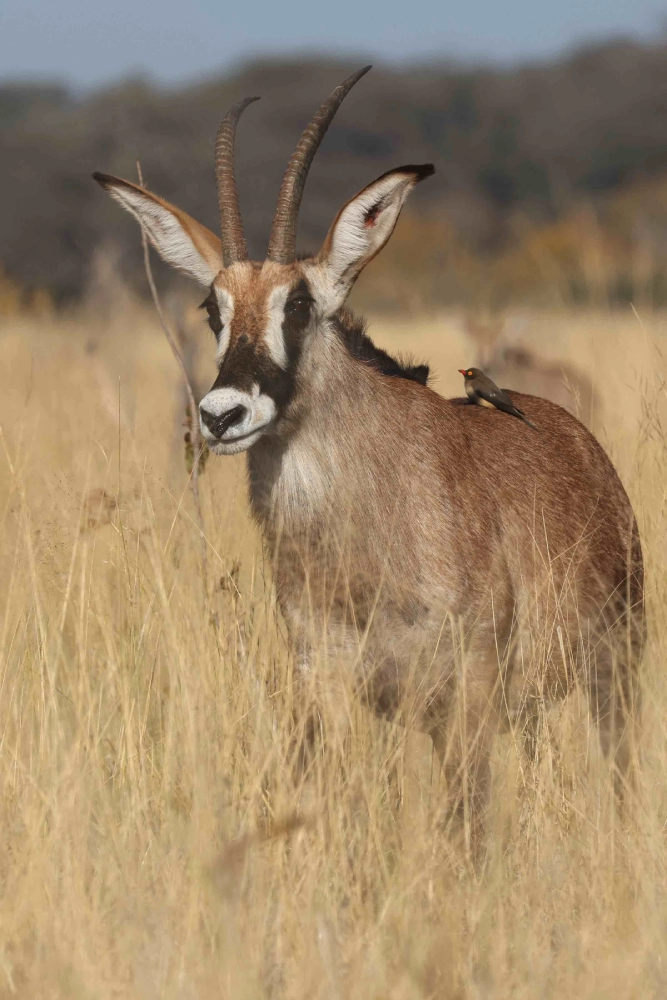
At Ngweshla we were rewarded with a sighting of another pride of six lion warming themselves in the early morning sun while draped in various poses over the trunk of a fallen tree. Closer to the pan, a lovely group of wildebeest lay peacefully resting while a group of zebra cropped the grass close by. A magnificent Sable antelope bull cautiously came to the pan for a drink as did a herd of kudu cows with young while the resident herd of impala looked on. A gorgeous Bateleur eagle in full plumage swooped down to the pan for a paddle and to quench its thirst.
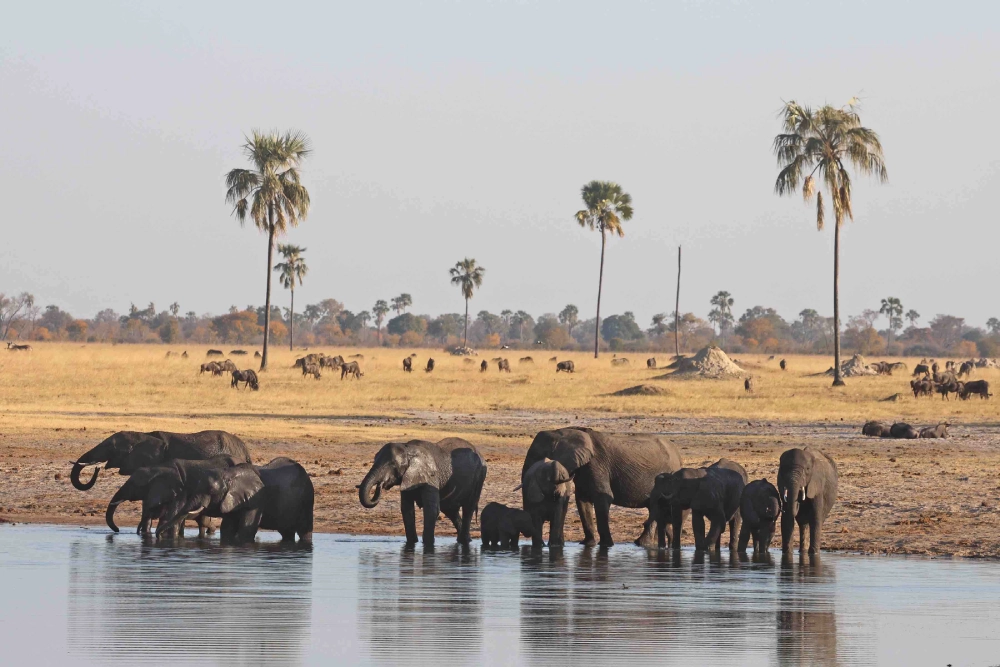
Traveling back to Kennedy campsite, the vlei was dotted all along with numerous ellies, and we were lucky enough to see a herd of ten roan antelope in tip-top condition at Kennedy 2 Pan.
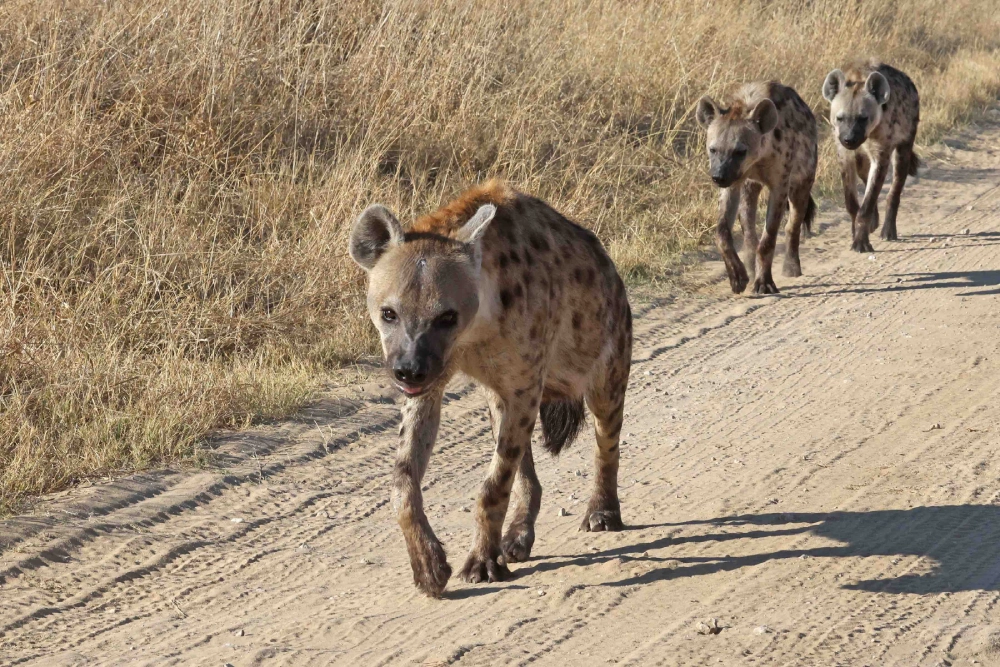
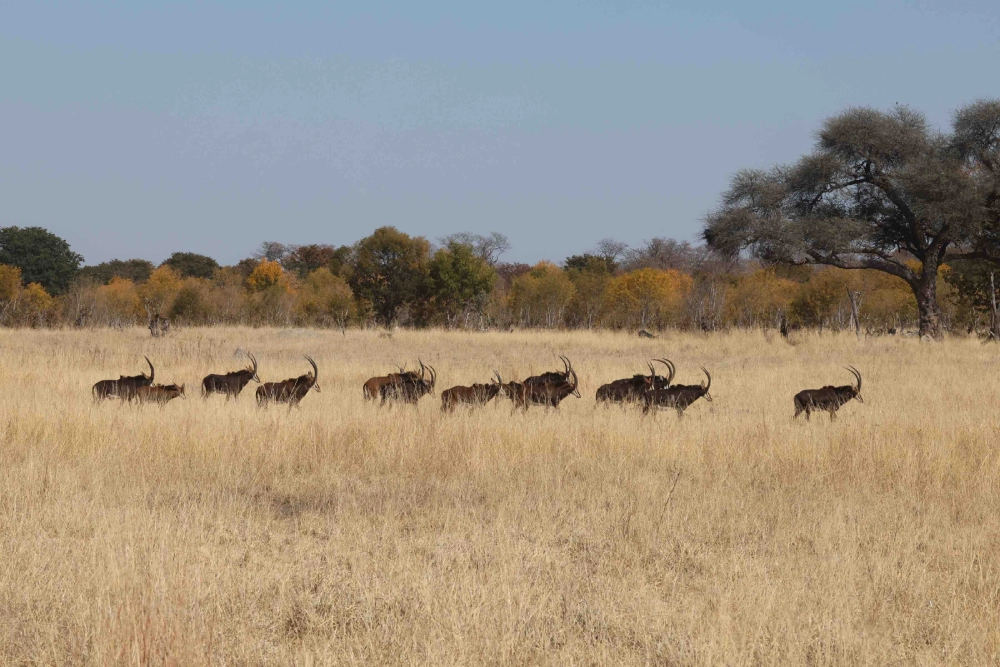
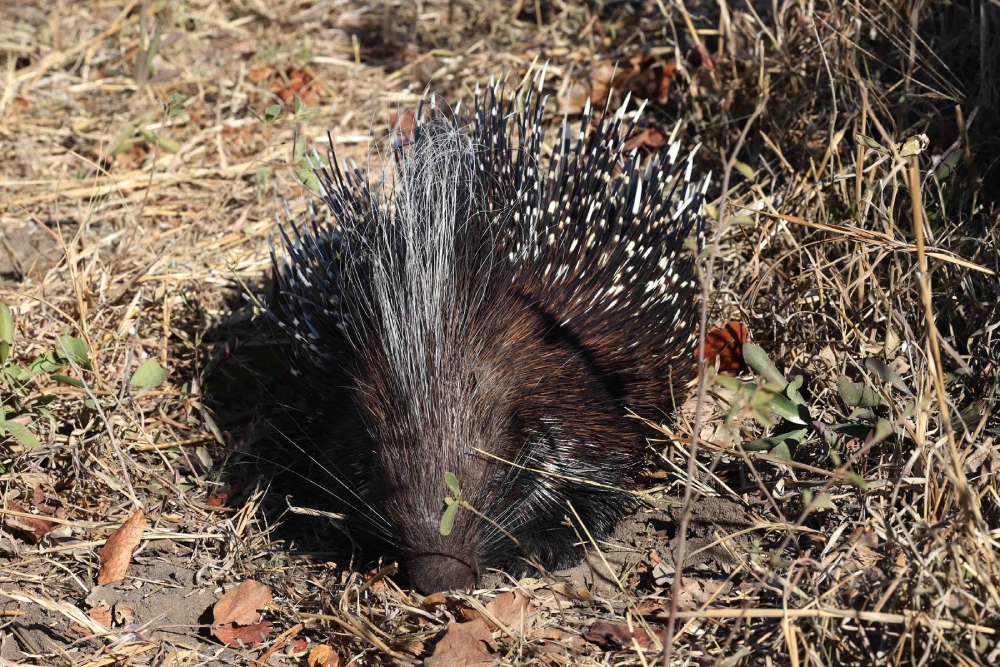
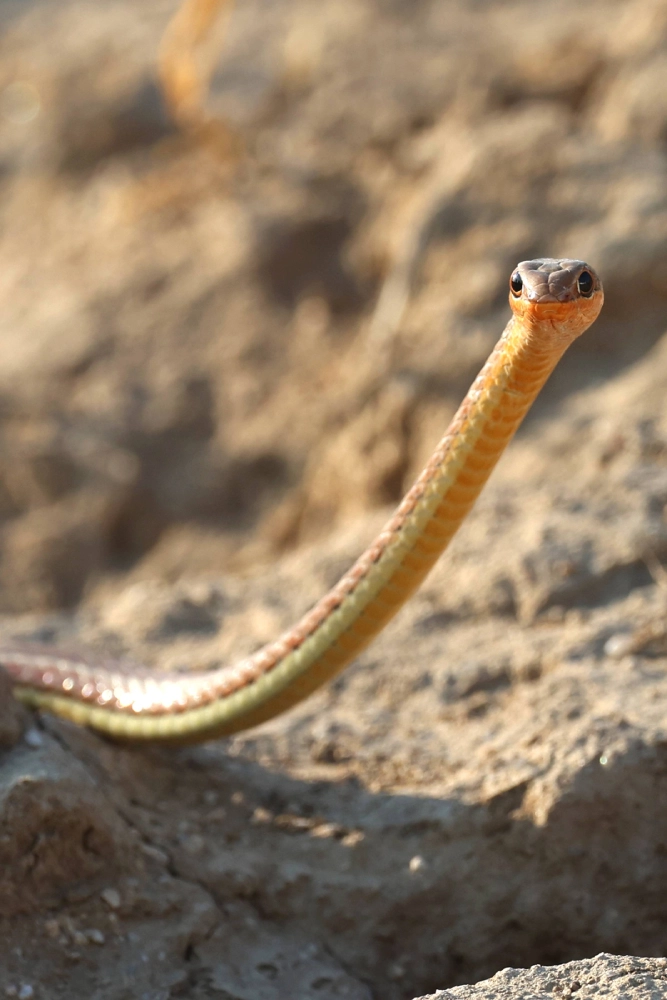 We found several lovely, chilled out herds of Sable, one group with some very small calves cavorting in the open grassland, and later we came upon a fabulous family of hyena out on an evening stroll. Other special sightings were a porcupine warming up in the early morning rays, and a nest of young yellow-bellied sand snakes that were occupying a termite mound.
At Mbiza there was some lion activity which was not surprising as it was teeming with potential prey. The bonus was a breathtaking sunset.
The tragic hunt of a well-known lion, Blondie, rocked the Hwange community during July. The lion was baited and shot within the Gwayi Environmental Conservation Area (ECA). Blondie’s home range was predominantly outside the park although he occasionally did venture inside the park’s boundary. Being only five years old, he was well under the recommended hunting age of seven years old that is stipulated by ZimParks as the minimum age to hunt a male lion.
Although found to be within the law, the ethics of this hunt must be seriously questioned. The incident has sent shockwaves rippling widely through wildlife circles and the public at large have expressed outrage. Blondie’s pride of three lionesses and seven one year old cubs have bomb- shelled and dispersed in his absence.
On the Friends of Hwange front work goes on unabated, and as the dry season kicks off in earnest, there is demand for more focus on water provision. Jason and his Game Water team have attended to numerous niggles and breakdowns at the water pans in past months some of which are listed below:
- Re-enforcing the support structure of a solar array at Caterpillar
- Termite damage at Secheche
- Attending to a faulty inverter at Ngweshla
- A slit in the pipe below the waterline in the Nyamandhlovu borehole that caused some scratching of heads to find and repair the fault
- Replacement of faulty inverters at Mabuya Mabema and Dynamite
- Replacement of a corroded motor and termite-damaged electrics at Jambile
The list goes on. In general, the water situation at the pumped pans is still good but it’s early days into the dry season yet. The numbers of elephant and other game visiting the water pans is increasing daily.
Harrowing of the fireguards was completed during July and covered a huge running distance of 230km in all. It included some tracks that have not been harrowed for years. Recently, work to open up an old fireguard that had grown closed was initiated. The process has been slow due to the density of the bush, but it will provide an alternative route from Main Camp to Dom Pan.
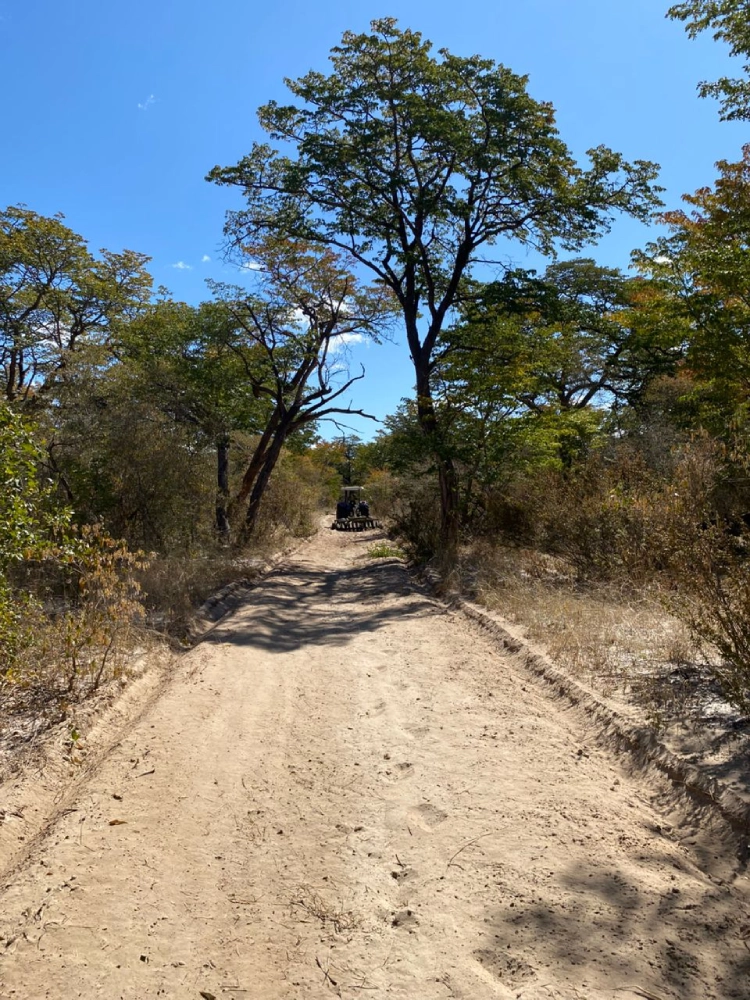
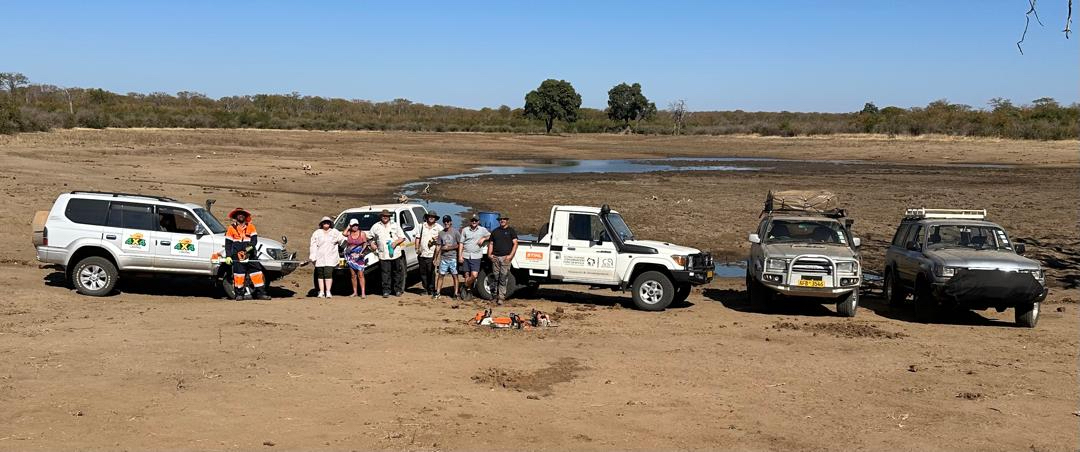
We were fortunate enough to have a team from the Harare 4×4 club come to assist with road clearing. Ralph Stead of Sawpower in Harare generously sponsored lubricants and machines for bush clearance and opening up of the roads. ZimParks supported the initiative by allowing the team to “wild camp” at the Mtoa ruins as this was central to the focus areas.
The roads were cleared fr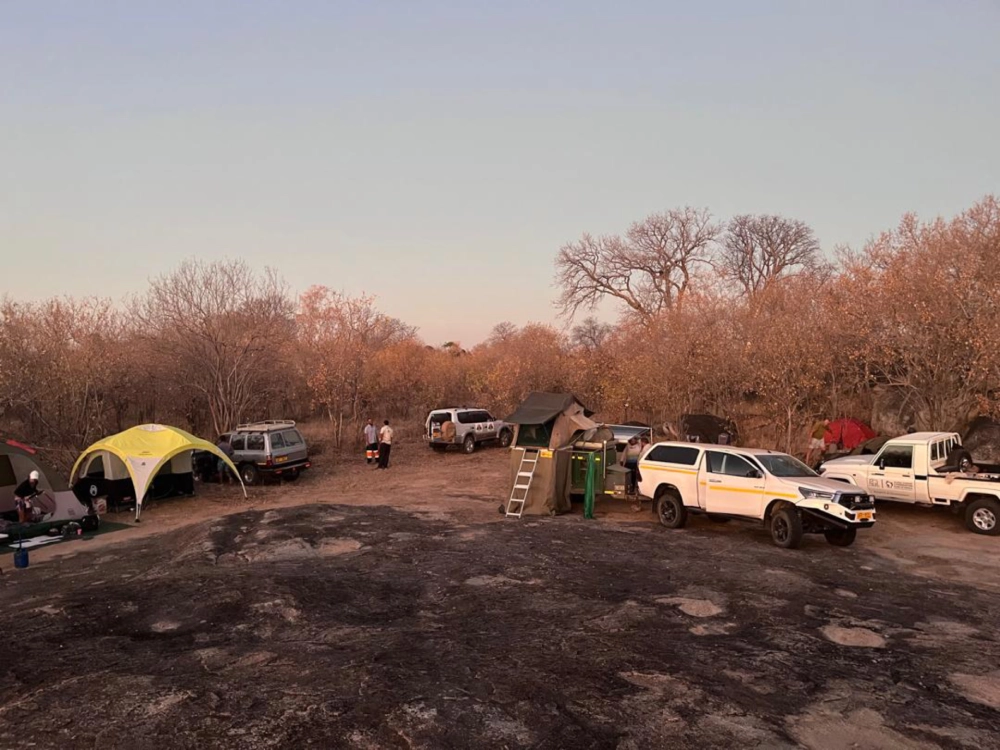 om the junction on the White Hills road to Mzizi Spring and on to the Mtoa ruins. Work continued from Mtoa ruins to Inyantue, thence to the Tchompani Dam junction and finally back to Mzizi Spring. The distance covered totaled a monumental 42km. We are hugely grateful to the participants for their time, dedication to the cause and the fantastic morale with which they undertook the task.
As well as acting as firebreaks, the clearing of these remote roads will facilitate a camera trap survey across the Hwange landscape.
The project is a collaborative effort between Hwange Lion Research (HLR) and ZimParks. The survey will be a valuable evaluation of the state of wildlife species across the ecosystem.
Our Game Water team assisted with the burning of major firebreaks during July. The burns were not as successful as we’d have liked resulting in an estimated 30% success rate due to the high water content still in the grasses. Unfortunately, we are obliged to adhere to the deadlines for burning set by the Environmental Management Agency (EMA), and were unsuccessful in our requests to burn later this year.
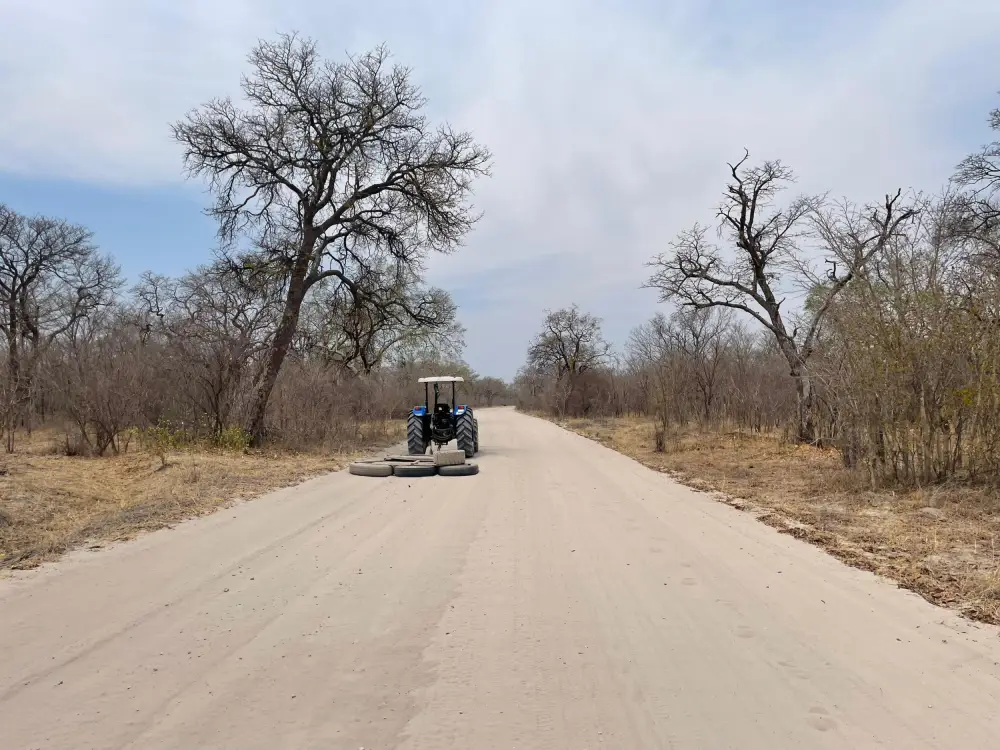
The team then moved their attention to road maintenance. Tyres were dragged along the main road from Main Camp to the White Hills junction to reduce the corrugation. Thereafter the road from Main Camp to Kennedy 2 was tackled after which the roads from Main Camp to Dopi, Dopi to Dom and Dom back to Main Camp were completed in preparation for the WEZ annual Pumping Legs for Water Fund-raiser that was held at the end of July. Regular dragging of roads is a necessary and ongoing exercise.
Things have been just as busy on the Anti-poaching front. As we get deeper into the dry season, with natural water supplies having all but vanished, we expect the next few months to become much more “eventful”.
 In June, the APU scouts participated in the Main Camp area road game count. This was followed by snare sweeps and patrols across five ranches in the Gwayi Areas in collaboration with Painted Dog Conservation (PDC). The exercise yielded a monumental but heart breaking number of snares. Over the course of two days, more than one hundred snares were removed ranging from those set to trap birds, to those intended for plains game. On this patrol, two poachers found in possession of three kgs of bushbuck meat were arrested.
Twenty wire snares set by these poachers were removed from the Gwayi riverbanks during Zimbabwe Republican Police (ZRP), PDC and FOH monitored operations. A live female bushbuck was released from one of these wire snares.
Towards the end of August, a joint seven day deployment with PDC in the Gwayi yielded 134 bird snares, two duiker snares and eighteen kudu snares. Local patrols have also been conducted in the Sikumi Tree lodge and Hwange Safari lodge areas where six snares where removed.
The AP team undertakes regular deployments on the Tchokomela Concession in collaboration with Hwange Rural District Council details. A number of wire snares have been removed from the airstrip area. Ongoing patrols and snare sweeps are vital in this known poaching hotspot.
 The team continues to monitor and apprehend wood poachers in forestry areas and on private land around the park. Several charcoal factories have been found in the Gwayi ECA where wood poaching is rampant. Together with Forestry Commission rangers the perpetrators have been challenged.
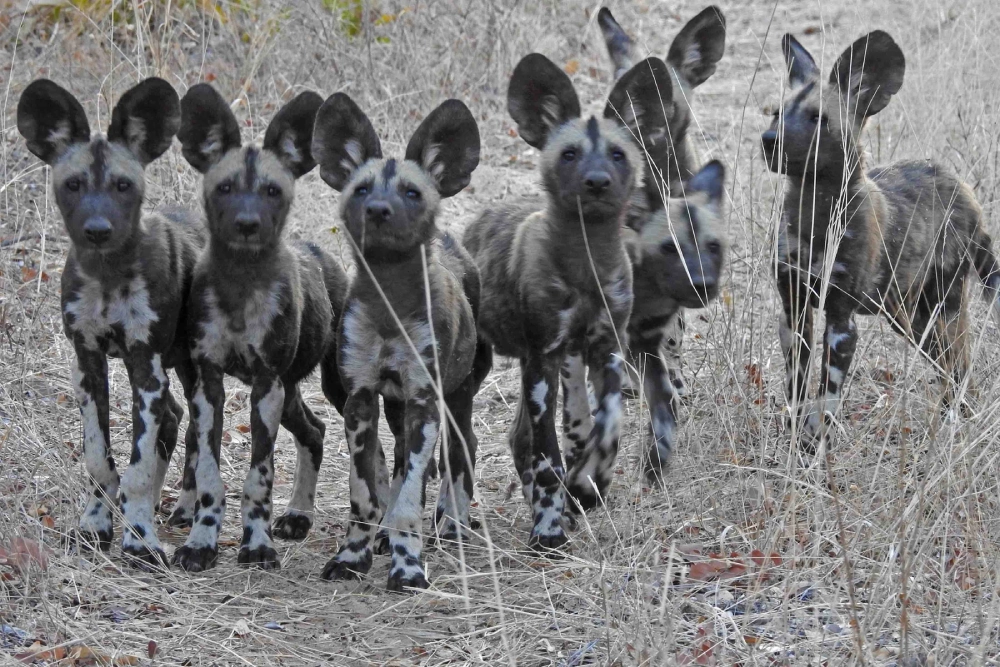
Recently, a pack of Painted Hunting Dogs established their den outside the Park in the Gwayi ECA and FOH has been assisting PDC to safeguard them. The pack has produced eight adorable puppies that appear to be thriving. Vigilance on the AP front remains key as snaring in that area is rife.
The AP team worked in collaboration with the Forestry commission this year burning firebreaks on the Nkonkoni estate that is situated on the Park’s eastern boundary and along the railway line as far as the Silwane concession.
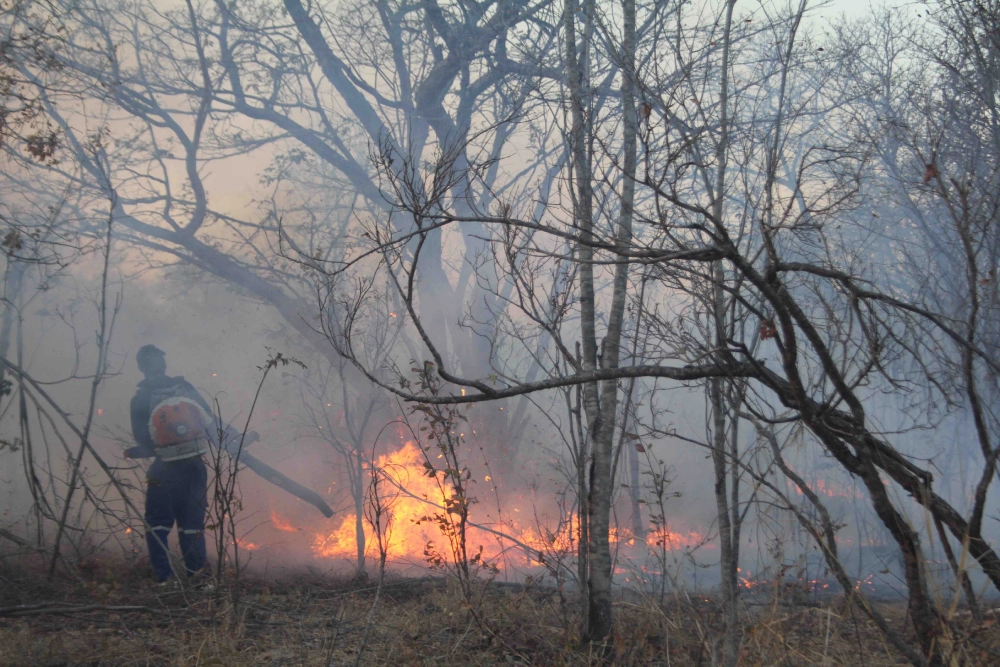
A fire that is suspected to have been started by the Mabale community on the Ganda concession burned for two days. While not huge in size, extinguishing it was quite a lengthy process. Teaming up with Forestry Commission and the Mother Trust APU the fire was eventually contained but burned a block of roughly 20 square kilometres. Forestry was most grateful for our swift reaction, transportation and the use of our valuable blowers.
The Ground Hornbill chick that was rescued from being struck by a car on the main entrance road in May 2025 was brought back to the Hwange landscape after having been rehabilitated by the Victoria Falls Wildlife Trust (VFWT). Together with ZimParks and VFWT the bird’s family was located and the chick was successfully released back to the wild.
 In conclusion, although we feel well placed to face the hot, dry months ahead, work on the Game Water front as well as the Anti-poaching front is relentless. We are urgently appealing for funds to keep us going to year end. FOH is totally reliant on goodwill and donor funding for its existence.We have had a generous fund-matching offer from one of our long-standing donors, so your contribution will have maximum impact.
Our most grateful thanks to you all.
Reporting: Carmen McGregor and Paula Dell
Image credit for Painted Hunting Dog Pups: Kelvinandy5930
Image Credits: Michael Shorey, Lucy Shorey, Carmen McGregor
We extend appreciation to ZimParks for their collaboration and assistance:
- The Director General Professor Edson Gandiwa
- The Regional and Senior Area Managers at Main Camp, Hwange National Park
- The Ground Staff and Game Water team at Main Camp, Hwange National Park